The Significance of Standard Cylinders in Optimizing Industrial Automation Systems
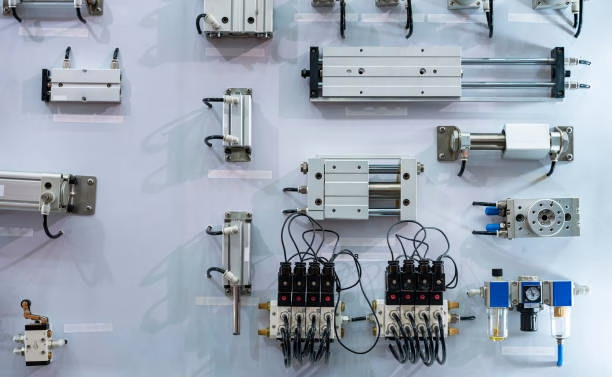
Every piece in the puzzle of industrial automation functions seamlessly helps in achieving efficiency, accuracy, and reduced costs. Standard Cylinders serve as a critical component of a pneumatic system as they supply motion and every piece of machinery works smoothly both on a micro and macro scales. For industries striving to achieve the best, collaborating with an automation parts dealer helps guarantee the quality of standard cylinders which are tailored to the operations of the business.
In the following sections, automation processes are explained, the primary advantages of standard cylinders are captured, the standard cylinders are captured, the standard cylinders are captured, and the relationship between pneumatic cylinder repair and long-term reliability of operations is described.
Standard Cylinders and Automation: An Overview
Standard cylinders are a kind of pneumatic actuators which employ compressed air to achieve linear motion. They are made to specific dimensional guidelines which allows for use in different brands and systems as there is a common between them. This works in the manufacturer’s favor by minimizing the time and resources they would spend in trying to fix the problem.
Within a contemporary automation parts dealer catalog, standard cylinders tend to be some of the most popular parts due to their use in many different automation applications, including assembly and packaging equipment. These cylinders are convenient to use because they have standard dimensions and mounting options, which help engineers concentrate on the system’s performance rather than on intricate compatibility issues.
The Importance of Standard Cylinders in Industrial Automation
Their importance stems from the capabilities of standard cylinders to generate precise motions repeatedly at a low cost. The demands of industrial production on the automation equipment’s durability and maintenance are well met by the standard automation parts, which are easier to maintain.
Here are a few notable aspects why these parts are so favored in industrial production systems:
- Interchangeable: Parts can be obtained and replaced easily without expensive redesigning.
- Versatile: Applicable in a wide array of operations ranging from heavy-duty to light-duty product assembly.
- Cost Effective: Standard design often results in reduction of production costs as well as availability.
Minimizing design variations leads to streamlined procurement, which in turn reduces complexity of inventory.
Industrial Automation Applications Using Standard Cylinders
Standard automation parts and equipment are essential for most industrial sectors focusing on automation, including:
- Manufacturing: Automated repetitive assembly operations.
- Packaging: Facilitating the motions for cutting, labeling, and sealing operations.
- Food and Beverage: To ensure that the products have sanitary and efficient handling.
- Automotive: Helping in the transportation of materials, welding, and assembly line operations.
- Electronics: Helping in the precise aiming for the assembly and testing of the circuit boards.
In these all situations, the standard pneumatic cylinders can be acquired through a reliable automation parts dealer. This makes it possible for companies to avoid costly downtimes.
The Relation Of Operational Productivity and The Tasks Involved In Repairing A Pneumatic Cylinder
Regardless of the work execution of a pneumatic cylinder, it will, at some point, undergo some maintenance and/or repair services. For companies that use automation, it is critical to understand the relationship between work efficiency and pneumatic cylinder repair.
A well-maintained pneumatic cylinder enhances the automation of actuator devices and streamline movement. It also diminishes the chances of air leaks, erratic movement, or parts misalignment which can inflict damages to other system parts and impair production efficiency. Preventive maintenance often involves:
- Diagnostics to identify the signs of wear and damage.
- A seal change to ensure airtight conditions.
- Reduced friction and longer life checks— lubrication checks.
- Cleaning of the actuator components to minimize the accumulation of dust and debris.
When an automation parts dealer is used, safety and reliability for performance is not compromised when an OEM-quality part is used.
Maintenance Tactics For Prolonging Equipment Lifespan
Having an effective maintenance tactic for standard cylinders allows companies to minimize and manage spending as well as maintenance. Following is a few of the recommended steps:
- Scheduled Maintenance Intervals: Carry out maintenance check-ups according to the protocol set by the OEM.
- Monitoring Performance Metrics: Employ an SMI and SEMA to monitor for anomalies on the cylinders.
- Spare parts inventory: Have the ability to aid critical replacement parts for the parts to ensure that the procedure is not impeded.
- Train Staff: Equip the operators and technicians to provide aid in resolving short and long term interlocks on the cylinders.
Having a proactive maintenance strategy will aid in the reduction of the need for repairs and have the pneumatic system running optimally.
Right Selection for An Automation Parts Dealer
Sourcing for good standard cylinders requires a good automation parts dealer and a good dealer will have:
- Technical support: Assist in the selection of the correct and most applicable cylinder for the intended use.
- Product availability: Ensure adequate stock on hand to provide prompt fulfillment.
- Compliance: Ensure that the relevant components have been supplied adhering to safety and industry regulations.
- Price: Reasonable prices while maintaining the set standards.
In many instances, maintaining a good relationship with your dealer will enhance the quality of after-sales service, including troubleshooting assistance and pneumatic cylinder repair.
The Standard Cylinder and Its Role in the Automation of the Future
The fundamental principles of the design of standard cylinders will always remain the same, but their functionality, longevity, and environmental impact can and will continue to be improved. Developments in the area of materials, seals, and consumption of air are proving to be useful in reducing costs and carbon footprint in the industry.
Increased dependence on data for decision making in automation might lead to the adoption of data collection sensors on standard cylinders to monitor in-work performance for predictive maintenance and reduced downtimes.
Conclusion
The functionality of standard cylinders aids automation in a number of industrial processes and their cost-effective functionality positions them optimally as a foundational feature of a manufacturer’s automation systems. Their cubic design aids in easy sourcing, swift swap, and wide compatibility, and helps other manufacturers to easily integrate them into their systems.
Knowing the relation of pneumatic cylinder repair and a pneumatic system’s life span helps businesses expertly manage the efficiency of their automation systems and help avoid system unplanned downtimes. A good automation parts dealer presents the businesses with automated systems products and offers the maintenance help needed to ensure unbounded reliability.